SALVAGING
(Copyright 2012 by Richie Swanson)
Bancroft Library listed Salvaging in Finding Aid to the Frontiers: A Journal of Women’s Studies Records 1972-2012
A window crashed apart, and fire leapt through the shards, leapt up the wooden frame, and I waited behind Auntie, watching through the doorway as little flames raced across the front-office floor, and she bent to her switchboard, talking to Philo’s Landing. “Bandages! Ointment! Doctors! Come on the north highway! Bridges are burned on the east!”
Chunks of fire dropped from the ceiling, and Auntie cranked her magneto, calling Marshfield, and the second board rang–Nathan Gearhardt in college in Salem asking about Queen Anne’s Hill.
“Every house burned up there,” I told him.
“Ellie, do you know my father’s Plymouth?”
I lied to hurry him off. “I saw your dad driving it to the river with your mom and sisters!”
A wall slumped, and we grabbed insurance papers, ran out the building and hedged on hot-cracking concrete. Flames towered from roofs across the block, roaring from Tupper’s Hardware, Moore’s Drugs, the Oregon National Bank. We ran toward Main, and Auntie steadied me, jerking my wrist. Just before I had run to the phone company, Valerie and I had been watching Errol Flynn, The Charge of the Light Brigade, and now flames spewed from the theater, and a window crashed next door–Jack Giles jumping out his pool hall, hugging his cash register, the cuffs of his pants on fire.
We beat them out, got in his pickup, drove Second Street to Front, and we saw Valerie’s mom pulling a hose from the river, her dad spraying their cinder-block station with a piddling mist, her brothers beating gunny sacks against popping-sizzling gorse. And Valerie was running around the gas pumps, kicking burning boards, and I shouted as we passed, but the fire ripped the air, booming like a monstrous gorge.
Giles drove Seal River Road to the turn to our house, but snags burned across it, and fireballs shot from pines on both sides. Giles hunched sweating over his wheel, his face lit to its deepest lines, and I had never been so near him, would never have talked with an arcade owner, you know. “I’ll bury my register here, then I’ll drive through it!” he shouted. “I’ll drive you to your house!”
“No!” cried Auntie, burn-holes everywhere in her backstitched jacket, her eyebrow-paint a melted mess. I opened my door, determined to go in by foot, because Auntie had made me her own after my mom had died having me sixteen years ago, and I knew her parents had built her house sixty ago, using timber from a wrecked lumber schooner. Auntie stiffened. She gulped against it, and Giles sped toward the beach.
We passed the last of the creamery, a blazing skeleton of brick window-holes and twisted-glowing machine shapes, and Giles stopped at the end of the road, right behind cars sunk in sand, packed with belongings. He took up his shovel to bury his register, and he waved us toward Missus Hafferty and her kids climbing the south jetty, and we ran across it, and a sailor rowed us across the river.
We got out, and all kinds of horns went off behind us, shorting out, and I thought Giles was signaling that someone had seen our house okay. But I turned to a battery of blasts, the gas tanks of cars, and Giles stood on the south jetty, raising a moonshine bottle in a pulsing red glow. He had come from French stock, had always had a devil’s smile, and he took a long, long swig, and Auntie watched him, wiping her lips, smudging them with ash. “Home’s gone, all of it,” she said.
We raced along the sand ruts of Na’ah Beach Road with hundreds who had been ferried from the town wharf, everyone talking about getting to the Jameson Hotel out on Riley’s Rock, everyone carrying something, a gal with microphones from a dance, a slicker with a jazz horn, Missus Staines with a potato sack of table silver.
Missus Hafferty ran to her husband squirming above the surf, and knelt over him, and he groped at her face, his eyes blotted and bloody from cinders. “I kin-naught see ye, Lydia, not any a’ ye!”
Auntie tore open his shirt, and his chest bubbled red, shiny like kelp-juice, and I lit out, nearly stepping on a mom and boys buried to necks in wet sand, cooling scorched skin.
The whole world smelled of burning trees, the waves sprayed sickly and warm, and all of the sea-sky reflected hideous heat.
Driftwood piles were burning, but the pines on North Seal Dunes east of the beach hadn’t caught yet, so I thought maybe the South Seal Dunes hadn’t either, and everything past our bridge on Alder Creek was still unburned. I climbed Na’ah Rock, a solitary beach rock one-hundred feet high, and I got to the wind-blown spruces on top, to the low-sprawling trees that had been my old hiding haunt–the old green cave–the pretend house that Valerie and I had tested our eagle-eyes from, looking down the beach and across the river and clear to the dips in the South Seal Dunes where sometimes we had seen whirlwind creatures, and most times Auntie’s chimney. But Auntie was right. The fire burned all around South Seal Dunes, and nothing remained of town but Smith’s gas station, the mill and cold decks at the river bend, and the Giant Red Demon was still coming down the Seal River’s valley, still leaping crowns inside timber-smoke, finding new fuel along the Seal’s banks.
Oh, the wicked thing.
I sank down on grass hummocks, and pangs made me weak–Joey Morgan and I had tongued kisses here last month, and he had popped girdle-snaps, had found me wanting him, and I had socked his gut good, and he had shoved me away. He had stood cussing, his cheek-muscles cable-tight, and I’d drawn my skirt back down to my ankles, and he’d stormed off and had been nowhere since.
And this evening I’d left Auntie’s porch, and the sun had been shining red and hot through forest-fire smoke, and I hadn’t hesitated. The sun had looked that way a few times last summer too, and so I just walked to Valerie’s house, thinking the scorching bleeding ball was the color of our hearts in our dimmest haze, Joey’s and mine, and I had felt all fluttery inside, hoping he would be at the show, and we’d sneak off, and I’d be out of school by Thanksgiving, kissing him proper in one of the mill’s cabins, married! And then the show started, the theater-lights came back on, and Fire Chief Dawson announced he needed men, and Joey stood in his high-collared jacket just five rows in front of us, and he’d plunked a smooch on Julie Bullard’s lips, fingering her hair.
And now I knew I was dumb and girly to be off alone, feeling Joey strong, and I couldn’t think if he was setting a back fire somewhere or was trapped against a pump truck or what.
Then I felt a stare on my back! A starving man sat just above me, tucking his knees to his chest in the old spruce-cave, his face a weak creamy brown in the fire-glow, his stare gunky and squinty and black, then coppery and shiny, then a deep-pooly brown like it had been taking me in since I had begun to walk up the beach. Half-hacked hairs hung from his chin, and he seemed as old and silent as Na’ah Rock herself, no shirt on, plenty of bone showing, nearly no breath, his pants and boots beat-up.
He showed sorry bits of gray-yellow teeth, looking off. Everyone yelled from the beach–the Jameson Hotel and its stairway on Riley’s Rock had caught from firebrands, and walls dropped flaming into the surf.
The bony-brown man said something toothy, and I edged my way up, and he said the name slower, and it still had too many hard letters to understand. “Tttlattnnittnk.”
I looked at him, disbelieving.
“That’s Creator Rock,” he said in English. “The first seals came out of there, the first salmon, the first birds, the first people.”
I had a fright, a jolt of meanness, and I raced down Na’ah Rock onto the sand again, and a deer snorted, leaping a drift log, fur on fire, and shadows raced through wood litter, rats. Cows bellowed in front of the surf, and I smelled dung close, Julia Moore the druggist’s daughter squatting against the rock.
All of town crowded the beach all night.
The wind changed, the fire and roar finally ceased, and the sun rose as it had set, red and bleeding again, glaring through smoke as dark as stove-soot.
No Sunday bells. No churches. No birds singing.
Waves swept in dull and heavy, and men shouted sudden, wading in, dragging out bodies of maids, cooks, tourists.
Auntie and I caught a boat back across the Seal River, and our shoes squished and sucked through boiled King salmon as we climbed the jetty.
State troopers allowed us through a blockade, and we walked hand-in-hand, our steps crunching charcoal from Nordstrom’s house and barn, the stink of their sheep singeing our breathing. We got to the top of our hill and looked down, and our chimney stood all by itself, and Auntie dropped to her knees, and I knelt, and she pushed me away and clawed the blackened road. “You saw the fire, Ellie! You left the house! You knew the wind! You walked right past the office and into the show! How, Ellie, how? You had that bucker on your mind, the way he pretends to look at you! Lord knows I would have done the same! Town on fire–”
“Not yet, it wasn’t!”
“I would have dropped everything to find Leo—to save the house.”
Leo her husband dead from the flue years before she had taken the train to the orphanage to get me.
Damn me, I thought, and I made my way toward the chimney, walking through the charred gate posts to the charred cement step, but rubble pulsed too hot, searing me, and I turned, and Auntie was still kneeling, raking her hair, and she glared vicious at me.
I killed her sister when I got born. And now I got so dizzy over a two-timer I let her house burn.
I walked downtown, and chimney after chimney stood black amid tubs, toilets, twisted pipes, iron bedposts, mounds of melted glass, and Smith’s Station was nothing but blown-up gas barrels and busted blocks, and a gray-bloused figure rose from rummaging, sucking stringy-black hairs against a black cheek. Valerie! She whooped and whistled and squeezed me and said the first barrel had exploded behind the station, warning her family. “Is Auntie all right?” she asked. “Joey just went to look at a body, you know–Julie Bullard’s dad, they think.”
I pushed it off, all of it, as much of it would go.
“They need you over there, Ellie.”
Soldiers were stringing an emergency line, and a sergeant pointed me into a tent that had an old ten-drop switchboard on a fish crate, and a slicker stood from hooking up a battery, smiling cautious. “Are you the operator’s niece? The one who stayed making calls with her?”
His teeth looked rich, his cheeks broad and sun-bronzed, and he was all blond, all snappy in a brown-worsted vest and starched shirt, and his hair-part was dry and wind-fluffed, smelling of fancy-Dan tonic even through the smoke stench, and his eyes lifted slow and curious like a mama deer, and they didn’t even look college-aged, his baby browns, not even soldier-aged.
I sat on a log behind the switchboard, wrenching my face at him, and he hooked up a second battery, hitching his shoulders like he was some kind of hero.
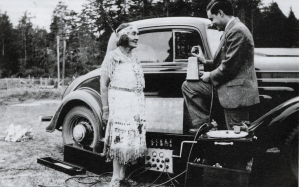
“I had them in my roadster for my eidophone,” he said.
He had a convertible? And a phonograph machine? But no food or drinking water or medicine?
“I showed the two nine-volts to the sheriff up in Marshfield, and he gave me the switchboard to drive here,” he said. “I brought a man from a breathing camp, and we hauled snags off the highway all night.” He sat on the log opposite the board. “I need to call Washington D.C., Doctor George Peabody Pyle.”
I gave him the candlestick-phone reluctant. “Two minutes,” I told him. “The sergeant says that’s it, not a second more.”
“I might need more,” he said. “Doctor Pyle’s at the Smithsonian Institute, but he really should be here.” The slicker lit up his eyes, looking serious at me, gripping the candlestick-phone like an old friend. “I grew up next to Doctor Pyle in Berkeley. He moved next door to my mother’s house when I was five, and he used to see me sitting outside on Mom’s stoop, and he would come over and pull harpoon heads, wedges and scrapers out of his pocket. And so I chiseled rocks, and I got good at making old stone tools, and Doctor Pyle would laugh and name them in all kinds of languages–Apache, Maida, Chumash, Modoc, Wintu, Paiute, Pomo, Washo, on and on. Mom would take in his washing and sewing, and then some mornings his Model T would just be gone. He would be away in the field for months, but now he’s stuck at the institute and has me in the field driving all over creation, interviewing Indians! He wants me to go to Columbia University!”
I cranked Portland, and Portland got him through, and he leaned forward like a horse-race rider, holding the earpiece to his head, his neck swelling all-proud against his collar. I watched the acid timer testy, and then he said the toothy word real slow to his professor. “Tttlattnnittnk, yes, I’m here, but I’m supposed to be at the Siletz Reservation tomorrow to finish with Old Koquille. Old Koquille says he knew birds when they were people, and he sees ghosts on the beach!”
“No, Andy!” His professor shouted through the line, and Andy listened on, and I unplugged the jack at two minutes, and he stood and shook my hand, his fingers feeling silky and flowery, not like they had moved any burning snags at all.
“Thank you, miss, you don’t know Doctor Pyle,” he said. “He trusts me, but if he thought I was in the wrong place, missing an interview, he would lose his wits. He said fires sometimes flush hide-outs from the woods, and I might meet some Indian we never knew existed. Do you know any Indians around here? Have you seen any?”
I wrenched my face again, and he bowed gracious, and I escorted him to the door-flap, my skin bolting hard, my insides flaming raw, my mind still seeing Auntie’s chimney standing all alone.
Andy walked to his red convertible, and burns dotted its white-rubber top like maybe half of what he said was true, and then the switchboard started to ring, and I stuck messages outside on canvas with army-issue pins.
Missus Bullard came in and called her father-in-law, sobbing, and Joey and Julie stood behind her, squeezing her shoulders, Joey’s cheek-muscle sinking solemn, his eyes fogging at me.
The husbands of burned-up maids made calls, notifying relations.
Thirty-three dead so far from Jameson’s Hotel, twenty-four in town.
Auntie came in tight-lipped, and she nodded me up and gave me a plate from the mill, steaming bread and red-sweating sausage and applesauce, and she sat in an oversized coat, handing me a requisition slip for Red Cross clothes.
“Auntie, I should have stayed at the house and rung you!”
“No, you would have burned!” She looked up with eyes as blue as a jaybird, crying. “I would have lost you! We did our best, staying in the office, didn’t we?”
A bell rang, and she glanced blinking at the ten-drop board and saw what I had only begun to remember. The same model had sat just outside our kitchen before Pacific Phone had built its Seal City office, and Auntie had put a play box beside it, had hung bells on the cardboard, had punched holes for wood pegs for jacks, had fixed up a can and string, so Little Ellie could take calls too.
And now Auntie grabbed the earpiece from the candlestick, and she curled her finger the same way she had whenever she’d made the receiver-hook go click-click-clack, and when she’d said quack-wack-wack, waving her nose like a duckbill, warning me I would be a dead duck if I ever eavesdropped.
Her eyes glistened moistly, and I went out, hearing Little Ellie and Auntie chiming the company’s vow and our own secret verse together:
“All Pacific Phone ladies
keep all their lips sealed,
the quietest phone operators
in all the telephone field.
But Ellie Duck and Auntie Duck
keep Seal City sealed,
the truest phone family,
with no quacking to yield.”
I found an old dollar dress with an embroidered collar and a hip-hugging sweater at Red Cross, and put them on and walked along Front Street, hunting a shovel to dig for our moneyboxes, and a tapping came furious at me–the roadster parked with the top down, Andy banging at a typewriter propped against his steering wheel, his cheeks smooth and soft and glowing, his hands possessed and believing, his smile talking to itself in some far-off world. He pulled a three-by-five slip from what I would learn was a language machine, English keys pounding out Penutian words, and he filed the paper in a little metal box, and somehow I saw him different, his face as bright as a polished pearl in the dirty-ashy air, his fingers leaping like gleaming surf-spray. He looked up, and he brightened the street, brightened the town, the whole world, and I nodded half-friendly, my tongue nearly tied. “I think I saw you your Indian,” I said.
A log barge ferried us across the river, and Andy drove Na’ah Beach Road, looking back at town, soldiers everywhere. “Jesus, it looks like the last war, like pictures of a bombed-out city in Europe!” He turned the roadster up the tide wash, and he looked at the charred slope of Nesi’ka Head, talking a blue streak, almost giddy. “Doctor Pyle says, `The flood is rising, Andy! The native languages will be washed away, swallowed by tuberculosis!’ Doctor Pyle thinks two language families might have met right here, that there was a tall white driftwood pole four or five miles past that headland–a boundary marker!” Andy eyed me keen. “Doctor Pyle thinks people here spoke Seal, Athabaskan, and maybe Hanis and Miluk, Penutian too! Maybe!”
He braked late for a cowherd, honking, and the cows swung around, bunching together. They shied from smoldering driftwood on one side, breakers on the other, and I got out and hollered, waving my arms, shaking my tail, feeling Andy watch.
I climbed Na’ah Rock ahead of him, holding my hope quiet, feeling my legs thick and boyish beneath my dress, my manners coarse, but Keekwillie was there, lying deeper inside the tree-cave, his face barely out of his bedroll, and Andy knelt easy, putting down a can of peaches and a sausage, but Keekwillie tucked his elbows beneath his chest and watched a horse-soldier riding along the surf, searching waves with field glasses.
I knelt to Keekwillie too and asked, “You got what you need? They’re giving away food and clothes in town.” Keekwillie kept watching the horse-soldier. “I saw you last night,” I said. “I saw Andy this morning. He said your word.”
“Tttlattnnittnk,” said Andy, and he nodded toward Riley’s Rock, saying how its name was the only word in the whole Seal language that Doctor Pyle knew, but if Keekwillie taught it to us, his language could live forever on a phonograph.
“You’re too young,” said Keekwillie.
“Seventeen,” smiled Andy.
Keekwillie laughed sharp, reaching deliberate for the peach can, sores and scabs on his arms, a rotten smell like cancer. He worked a log-camp knife around the can’s rim and swigged the juice all at once like Giles and his moonshine, his Adam’s apple a hard pecan pushing pointy against his throat.
He slurped the peaches and glared gunk-eyed at Andy. “If I tell you Seal words, maybe I’ll drown. Maybe you’ll drown, maybe she will. Maybe I’ll lose my voice, and I’ll die and search for it forever.”
But Andy took out a couple dollars, Keekwillie folded them into his palm, and Andy handed me his professor’s notebook, moving his cheek close to mine. “Will you take shorthand?”
“Sure, I will!”
Andy pointed at his head, hand and arm, at beach rocks and landmarks on the river, and I wrote the names Keekwillie gave them, making triple consonants when Andy wanted, feeling his looks deep and bright, his cheeks flexing strong, and then the tide went down, and the horse-soldier rode out between charred timbers, and he hoisted a dripping body behind his saddle, and Keekwillie swallowed a gulp as thick as sand.
“I pulled out a mother,” he said, “my second mother—Na’ah Lang.” He checked a look from Andy, glaring again. “That was her white name. The soldiers made it from the trade language when they came down the valley. They swept this valley clean as this fire. They burned lodges all the way down. I was just a boy, so my first mother sent me to hide up here, and when the soldiers got Na’ah Lang on the beach, I saw them swing their swords. They cut her up like a cannery fish and took everyone else away, and I picked up her pieces, picked up a dead brother and grandmother too.”
“Eighteen hundred fifty-six,” said Andy.
“Na’ah Lang cut out a lieutenant’s heart with a razor clam,” said Keekwillie. “But I was here on this rock when that lieutenant pointed his pistol and marched her into his tent the night before.”
Keekwillie watched the horse-soldier and body move up the beach, and Andy did too, and I snuck a gaze at the soot-cloud hovering above town, because I knew Auntie worked the switchboard all alone, nobody else to help.
“I near’ sold some things to a museum,” said Keekwillie. “I got a trunk buried, shell-money strings, a ceremony dress, basket caps, woodpecker crests.” He labored to turn his head toward Nesi’ka Head, brushing against the spruce-cave. “Twenty dollars, I’ll show you. The tide’s still low enough you can drive your car.”
Andy paid and then lifted Keekwillie gentle, helped him put on a hole-ridden mackinaw, and he tied Keekwillie’s boots, leaning full into the cancer smell, afraid of nothing. He kept hold of Keekwillie stepping half-blind down the rock, and he tucked a blanket around him in the front seat of the roadster, and I thought of Auntie again, the switchboard, and then Andy pressed fingertips against my back, guiding me into the rumble seat, and I sat tingling beside the eidophone, bound to catalogue my first artifacts.
Andy drove up the beach, following jeep ruts, and we started around Nesi’ka Head, the tide-mud slapping loud, and Keekwillie shouted, “Farther out! Too many rocks close in!”
What rocks? I wondered, and Andy swerved, and I flew cockeyed, the seat slamming my back, bucking, stopping. The engine gurgled and died. The car was stuck, leaning, and I got up, and then plunged bosom-deep into a tide-pool, and Andy was in it too, flailing, spitting, and we climbed out slipping on seaweed, and the roadster was still there, one tire oozing muck through its spokes, another hanging off a rock. Keekwillie wobbled up in the front seat. He leaned into the back, grinning skinny-toothed. He grabbed the metal boxes, the files of Andy’s interviews. He tossed them away from us, flinging them everywhere. He tossed phonographs, books, papers, the microphone, speakers, the notebook into the surf, and then he pushed spry out his door. He walked nimble, his shoulders lurching with victory, and he dropped the blanket in tide sand and stepped around Nesi’ka Head, not looking back, and Andy cussed, splashing, fishing things from water, and I braced a shoulder against the roadster, shoving, and it didn’t budge. I got me a drift log, wanting to pry the back tire, but then Andy was nowhere, and a wave slammed against the roadster, swept backward, and the car rocked…tilted…slid down into the tide pool. The big bug-eyed cowl lights went under, and Andy screamed, hauling himself up from a kelp-tangle, sleeves drenched, skin purple with cold, and I ran to him, and I hugged him hard as I could.
“Jesus, Ellie!” Andy stared helpless at waves rolling over the tide pool. “Doctor Pyle! His car! Our files! His roadster! His work!” Andy moaned at himself, shivering. His face bit down on itself, and the sun slipped sudden beneath the smoke-haze, pulsing pink from an electric-violet horizon, and his cheeks clenched gold, flooding rose, and I reached to him like Joey would me—except I trembled, seeing my breath on his cheek, and I raised his chin, cupping my touch like Auntie would, knowing to take command like Auntie.
I led Andy by an elbow, picked up Keekwillie’s blanket, tucked us out of the wind against the headland, and I blew on smoldering driftwood and stacked on pieces, and Andy paced beside head-high flames, still shivering, dripping. “God damn me!” His teeth chattered, he shook all over. “What a fool I am! A trunk buried! A museum! Jesus!”
“Andy.” I took his hands. “I’ll turn away. You take off your clothes. Put yourself in this blanket, or you’ll shiver to death.”
“Doctor Pyle got this blanket from Missus Sherman Manygoats, Two Grey Hills, Navajo! Trusted me with it!”
“You have to take off your clothes, Andy.”
“Doctor Pyle—”
I unfastened his vest-buttons, his deer-eyes watching, comprehending slow, and finally he took off the rest, and I turned around and peeled down to my underclothes, my crotch hair drenched conspicuous against Red Cross bloomers, my nipples showing against my brassiere.
Andy sat on a blanket-corner in city-style drawers, tight and revealing, and he rubbed ruddy-purple legs, and I plunked myself down beside him, and I put an arm around his shoulders, and he slumped, burying his face above my brassiere, and I lay back, tugging him close, and before the night was done, I gave him all my heat, every bit, all I wanted, all I thought I had left.
And afterward we slept, and I woke with his hair damp and sandy and silky on my face, his chin snug on my shoulder, and I eased his head down, and I got up and tiptoed from the little-low fire-glow, feeling him every step, figuring Auntie would know soon as she saw me. I got me my dollar dress and slid it over my head, and Andy woke before it was all the way down my legs.
“Ellie, you leaving without me?” He sat up, pulling the blanket across his lap. “Can you wait? Help me tell Doctor Pyle? Give me more than two minutes?”
He turned his back, dressing, and he slung his arm around me, walking the beach toward town, and we still walk it today. He’s my mister, you know, and I’m his missus. We taught at a university thirty-five years, bringing Seal Indians to graves, examining remains with sound, heat, computer pictures and ancient stories, no digging anymore.
We always knew Keekwillie had given us the most from all our salvaging–each other. Old Indians from the Klamath Agency had told us Keekwillie had escaped a trail of tears, hiding in a myrtle swamp, and a Klamath family had found him during a hop-picking season, working as a boy, and they had made him one of their own. Yet we never put Keekwillie’s life solid on paper, not even after we retired back here in Seal City–rebuilt and grown so big Valerie owns three gas stations and two Circle K’s.
Because writing Keekwillie’s life never seemed total and true, for Seal City belongs now to our people, and merely echoes his.
NOTES
Na’ah means mother in the Chinook trade language.
La-lang means “The Tongue; a language” in Chinook. The French is LA LANGUE.
Keekwillie means “low” in Chinook. Keekwillie chuck means “low tide.”
Nesi’ka means “we; us; our”, a pronoun in Chinook.